
Denture Adhesive Test 2026:
Britain's 7 Top Brands Put to the Test
Which? hasn't published a proper denture-fixative comparison in years.
In that gap the market has quietly shifted: new manufacturers have arrived, old brands have reformulated, and one product category has barely been covered by the consumer press at all. Our editorial team commissioned its own twelve-week, real-world comparison with a full-denture wearer, putting seven of the UK's most-bought adhesives through the same kitchen-table tests anyone reading this would care about. The result genuinely surprised us.
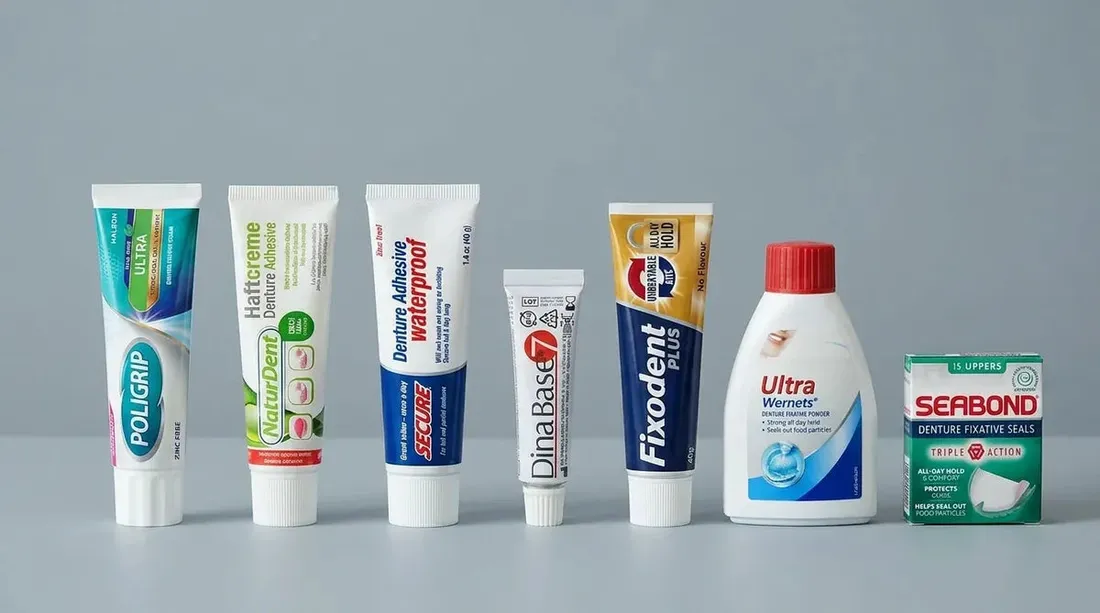
The seven adhesives our editorial team put through twelve weeks of daily use. Photo: Dentalcare Guide
Six of the seven adhesives we tested lasted fewer than eight hours in normal daily use, despite manufacturers promising an all-day hold. One mainstream brand still contains zinc, a decade and a half after the FDA flagged the long-term neurological risks. The winner, scoring 96 out of 100, our Best Buy, is not a denture cream at all. DinaBase7 is a thermoplastic denture gel developed by a German prosthodontics laboratory, applied once and holding for a full seven days.
Our Tester

How We Tested
- Hold under real conditions: tea, toast and apple tests, repeated across different days and meal types
- Ingredients: full INCI lists cross-checked against manufacturer pages, package leaflets and Boots/Amazon UK listings (April 2026)
- Cost per day: calculated at the manufacturer's recommended frequency of use
- Customer-review analysis: 50 reviews per product across Boots.com, Amazon UK and Trustpilot
- Overall score: /100 with weighted sub-scores across seven criteria
The Rankings in Detail
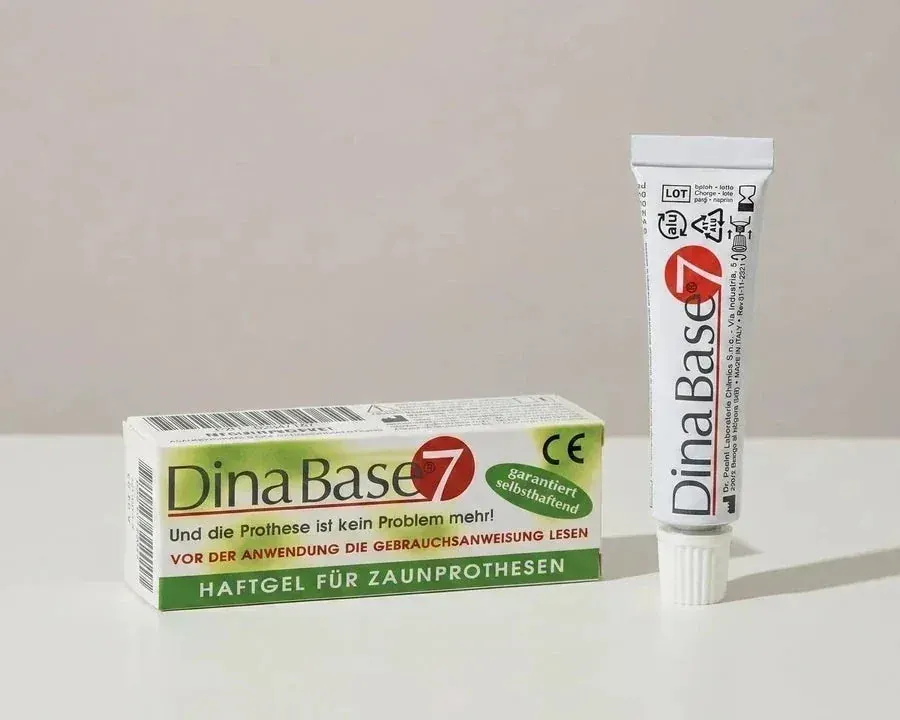
DinaBase7 Denture Gel
£14.99 per tube (lasts roughly 4 weeks)
DinaBase7 is the one entry in the test that doesn't sit in the traditional adhesive-cream category at all. Rather than a glue, it's a thermoplastic denture gel, essentially the same material principle that dental laboratories use when they reline a denture for a patient whose jawbone has shrunk and whose plate no longer seats correctly. The tube is warmed briefly in hot water until the gel is mouldable, like a soft putty, then pressed onto the inside of the cleaned denture and seated. As it cools it firms back up into a soft, slightly elastic layer that fills every gap between the gum ridge and the denture base, creating a quiet suction-cup effect that holds through eating, talking and laughing. One application lasts seven days. In twelve weeks of daily wear our tester never had to reapply mid-week.
What also struck us was the ingredients list. DinaBase7 is zinc-free, contains no mineral oil and no azo dyes. The material is based, according to the manufacturer, on naturally-derived polymers and the product carries CE certification as a Class 1 medical device. At £14.99 a tube the headline price sits well above what you'd pay for a tube of cream from the chemist's, but because one tube covers roughly four weeks, and because you're not applying it twice a day, the daily cost works out at around 28 pence. In other words, no more expensive on a per-day basis than the premium cream brands.
- Holds for seven full days from a single application
- Zinc-free, no mineral oil, no synthetic dyes
- Works even where the jaw ridge has significantly resorbed
- Suction-fit mechanism, no sticky residue to scrub off
- 30-day money-back guarantee
- First application takes around fifteen minutes (warm, mould, seat)
- Higher up-front price than a chemist's cream
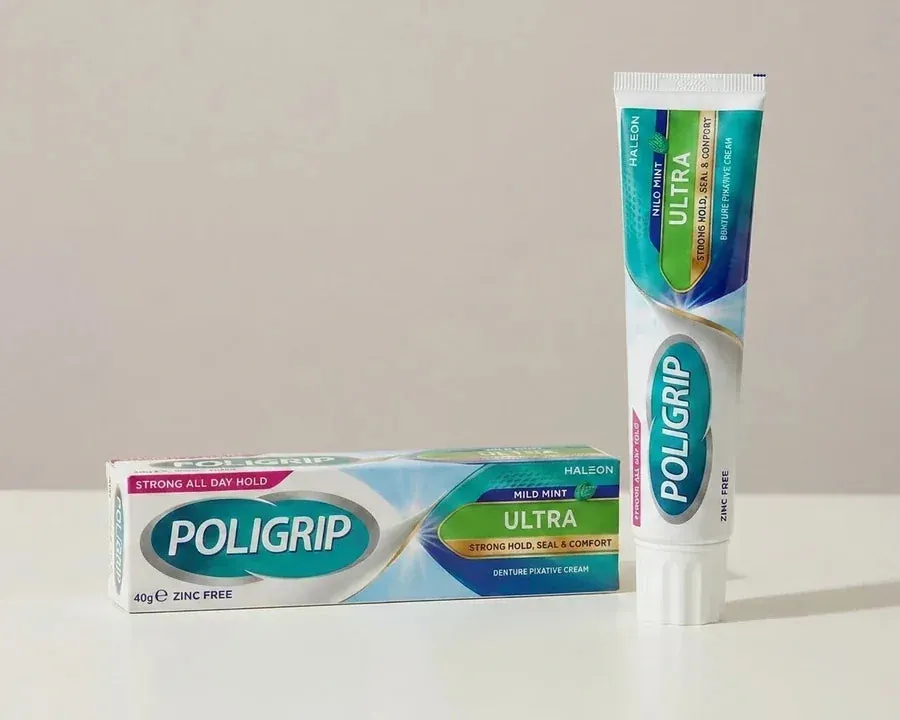
Poligrip Ultra
Poligrip is comfortably the best-selling denture adhesive in Britain. Haleon, the company spun out of GlaxoSmithKline in 2022, markets it on an “all-day hold” promise. Real-world use looked rather different. Depending on the meal, our tester needed to reapply somewhere between four and eight hours in, which echoes a great deal of what you'll read in the customer reviews on Boots and Amazon.1 Another recurring complaint, and we saw this ourselves, is the tube itself: after three or four uses the product near the nozzle started to set hard, and a meaningful share of each tube ends up unusable.
To Haleon's credit, Poligrip Ultra is genuinely zinc-free across the whole UK range. The base, though, is the same paraffinum-liquidum / petrolatum (mineral oil derivatives) that virtually every chemist's cream relies on, together with two azo dyes (CI 73360 and CI 15850) that consumer groups have flagged as potential allergy triggers.6 The 14 pence-per-day figure sounds cheap on the shelf, but with two-to-three applications a day the genuine daily cost is closer to 30 pence.
- Genuinely zinc-free across the UK range
- Available in every Boots, Tesco and corner pharmacy
- Real-world hold of four to eight hours, not the “all day” promised
- Tube hardens at the nozzle after a few uses
- Mineral-oil base, two azo dyes
- Taste described in many reviews as “not quite neutral”
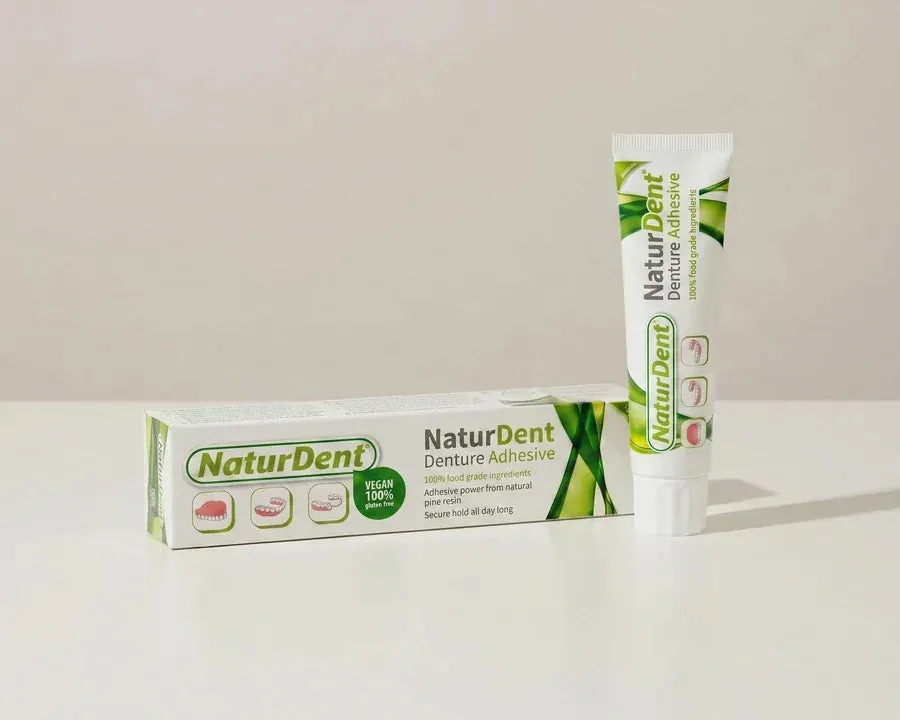
NaturDent
NaturDent is the natural-positioning cream in the test. The pack and the marketing both lean heavily on the food-grade ingredient claim, with natural pine resin as the binding agent rather than a synthetic polymer. In real-world use it produced the longest hold of any premium cream we tried, in the region of six to nine hours on a normal day, and our tester noted it had genuinely no after-taste, which the chemist's brands often struggle with.
The downside is the transparency problem. NaturDent's UK retail listings do not publish a full INCI list, which would be enough on its own to lose marks. The bigger concern is that pine resin (also known as colophonium or kolophonium) sits on the standard dermatological allergy panel and is a recognised contact allergen for a non-trivial minority of patients. The packaging mentions “natural” many times but does not flag this. NaturDent is also imported from Austria via UK pharmacy distributors and isn't stocked widely outside Amazon and specialist denture-care retailers, which keeps the per-day cost stubbornly above £0.25.
- Longest real-world hold of any premium cream in the test (6–9 h)
- Zinc-free, paraben-free, no synthetic flavour
- No detectable after-taste
- Full INCI list not published in UK listings
- Pine resin is a known dermatological contact allergen
- Imported from Austria, limited UK distribution
- Around 27 pence per day at recommended use
DinaBase7 delivers what the others only promise.
One application, seven days of hold. See for yourself what sets our Best Buy apart from the rest of the field.
Our Best Buy →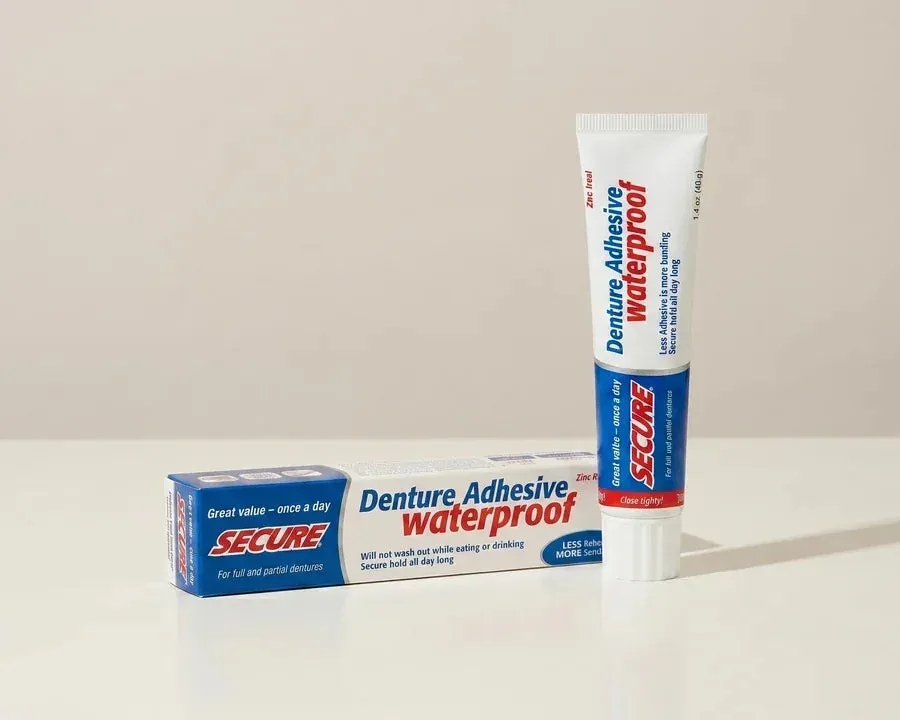
Secure Denture Adhesive
Secure markets itself as “the world's only truly waterproof denture adhesive” and has built a loyal following among UK buyers who pay the import premium to get it. It does what it promises in one specific respect, the adhesive does not redissolve in coffee, tea or warm soup, which is a genuine advantage if your day revolves around hot drinks. Hold-time in normal eating sat at five to seven hours, which is not far off the mainstream creams.3
The downsides are practical. Because the adhesive is non-water-soluble, removing it at the end of the day takes notably more scrubbing, several Trustpilot reviewers describe it as a chore. The tube is fiddly with a narrow nozzle that crystallises quickly, and the same review threads include a number of complaints about cracked or hardened tubes arriving in shipment. Ingredient-wise the formulation is zinc-free but still mineral-oil based, with a synthetic silicone component (cellulose gum and PVM/MA copolymer) that is fine for healthy gums but irritates some users.
- Genuinely waterproof, survives hot drinks intact
- Zinc-free, no artificial colours, no flavour added
- Hard to remove at end of day (the flipside of waterproofing)
- Tube fragility and crystallisation reported repeatedly
- Highest price-per-tube in the test
- Imported, limited UK distribution outside Amazon
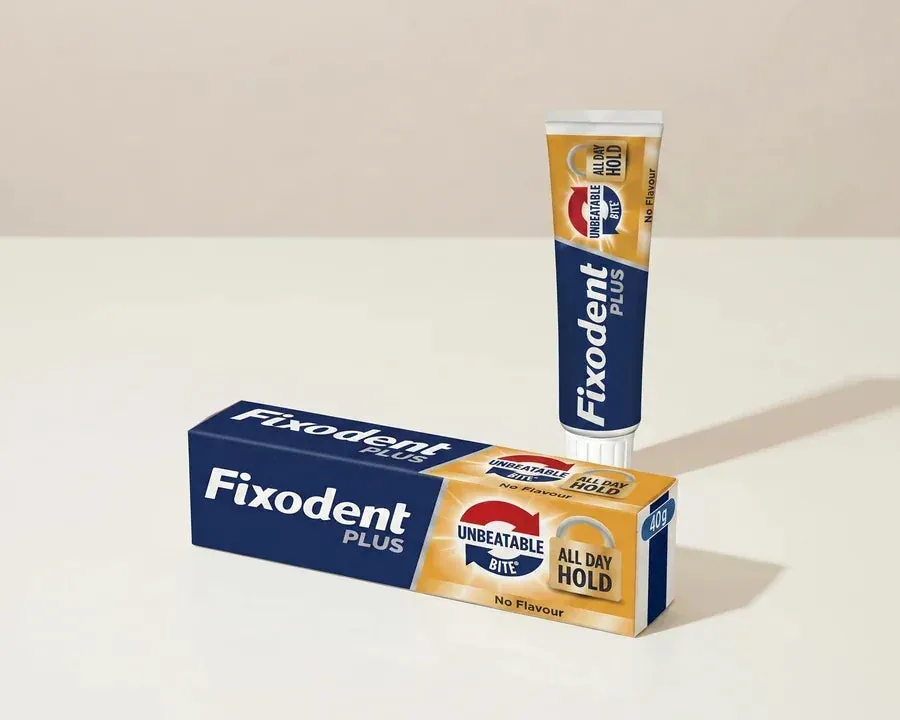
Fixodent Plus
This is the heaviest finding in the whole test. Fixodent Plus still contains zinc. Procter & Gamble lists it on the UK FAQ page in plain English: among all the major UK adhesive brands, Fixodent is “the only one that still contains zinc.”4 Long-term, high-volume use of zinc-containing adhesives has been linked since at least 2010 to copper deficiency and the neurological symptoms that follow it, numbness in the limbs, unsteadiness on the feet, and at the severe end, neuropathic gait disorders. The US Food and Drug Administration issued formal guidance in 2010, after which GSK pulled its zinc-containing line. P&G kept Fixodent on shelves and added a small-print warning about “consulting a doctor if using other zinc-containing products.”4
The day-to-day performance was unimpressive too. Hold-time landed at three to six hours, and the cream's distinctive sweet mint flavour was the single most complained-about feature in our customer-review scan. The cream itself contains BHT (a synthetic antioxidant under hormonal-disruption scrutiny), the same paraffinum-liquidum / petrolatum base as the rest of the market, and the azo dye Acid Red 18 in the pink colourant.
- Universally recognised brand, available everywhere
- Headline price among the cheapest per tube
- Still contains zinc (the only mainstream UK adhesive that does)
- FDA warned about zinc adhesives in 2010; many manufacturers reformulated
- Real-world hold of only three to six hours
- BHT, mineral oils, Acid Red 18 azo dye
- Strong artificial mint taste, disliked in reviews
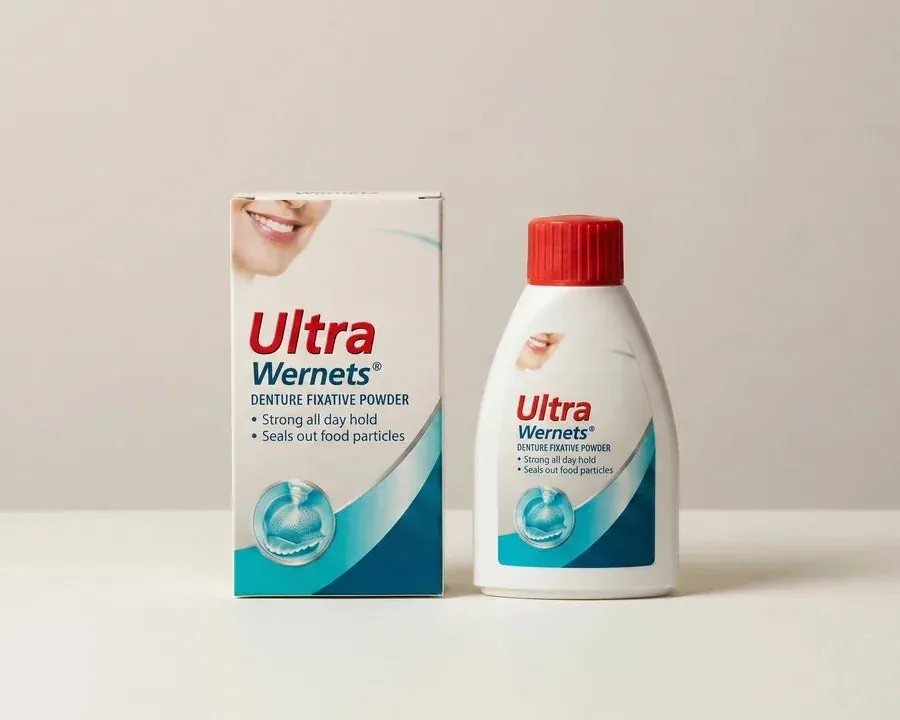
Wernet's Powder
Wernet's is a powder rather than a cream, one of the very few denture fixatives still sold in that format in Britain, and a regular fixture in the older pharmacist's range. You shake a fine dusting of powder onto the dampened denture base, seat the plate, and the powder absorbs moisture to form a gummy seal. In principle it sounds elegant. In practice we struggled with it. Hold-time on a normal day landed at one to three hours, and as soon as our tester had hot tea, the powder dissolved noticeably faster than that.5
The other issue is dosage control. Too little powder and there's barely any hold at all; too much and the excess slides out around the edges of the denture, leaving a gritty texture under the lip. Wernet's also sits among the more expensive formats per day, because a fresh dusting is needed for almost every meal. The brand has a long heritage in the UK market, it's been on chemist's shelves for decades, but the format itself has been overtaken by the modern cream tubes and, increasingly, by gel alternatives.
- Zinc-free, no artificial colour, no flavouring
- Easy to clean up, no sticky cream residue
- Real-world hold of only one to three hours
- Dissolves quickly with hot drinks
- Difficult to dose, gritty texture if over-applied
- Higher daily cost than cream alternatives
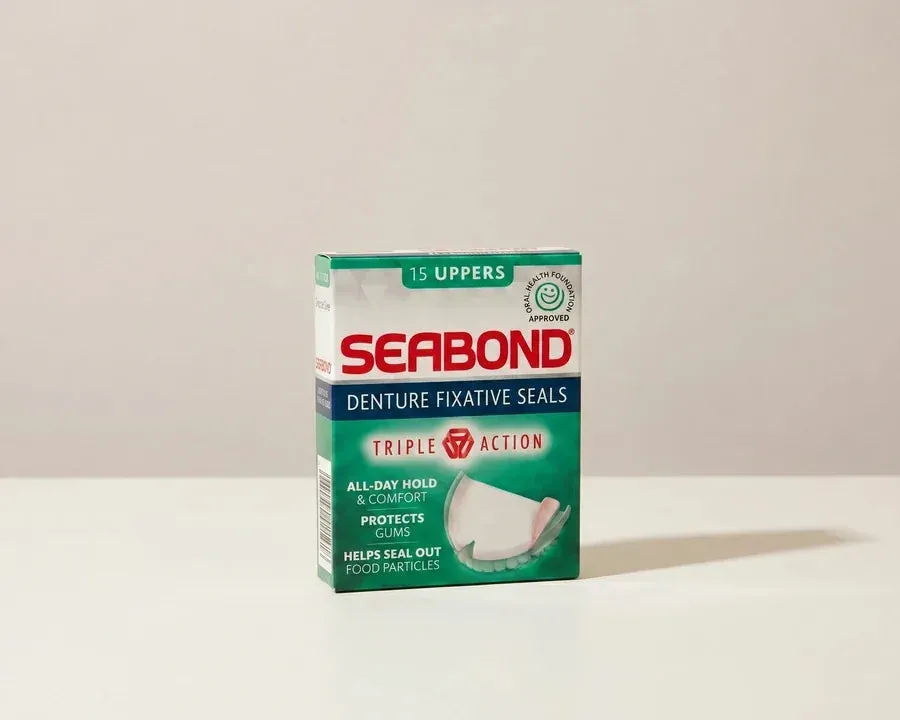
Seabond Denture Seals
Seabond is the outlier of the field, not a cream and not a powder, but a thin adhesive wafer cut to the shape of an upper or lower denture. The pitch is appealing: no mess, no sticky tubes, just a strip you wet, fold onto the denture base and seat. In our test the wafer worked tidily enough for the first hour or two but the hold dropped off sharply after that, falling to one to three hours on a typical day. Several reviewers describe it “turning to slime” once warm food enters the picture.
The packaging positions Seabond as a “natural alternative,” which deserves a closer look. The wafer is made from a cotton blend coated with a natural-vegetable-gum adhesive (mostly karaya gum). That sounds clean, and it is, in fairness, zinc-free and dye-free, but karaya gum sits on dermatological allergy panels and is a documented contact allergen for a small but non-trivial proportion of users. Seabond also doesn't suit anyone whose denture sits closely against the gum, because the wafer adds a few tenths of a millimetre of bulk that can throw the bite off.
- Zinc-free, dye-free, no synthetic flavour
- Tidy, no tube residue or scrubbing
- Hold drops to one to three hours under normal use
- Adds bulk between gum and denture, can throw the bite off
- Karaya gum is a known contact allergen for a minority
- Among the most expensive per day in the test
All 7 Brands Side by Side
The headline numbers from our test in one view. Hold and ingredients carried the heaviest weighting because, in our view, those are the things a denture wearer actually has to live with.
| # | Product | Score | Zinc-free | Per day | Hold |
|---|---|---|---|---|---|
| 1 | DinaBase7 Denture Gel | 96 | ✓ | £0.28 | 7 days |
| 2 | Poligrip Ultra | 76 | ✓ | £0.18 | 4–8 h1 |
| 3 | NaturDent | 73 | ✓ | £0.27 | 6–9 h |
| 4 | Secure Denture Adhesive | 71 | ✓ | £0.28 | 5–7 h3 |
| 5 | Fixodent Plus | 68 | contains zinc4 | £0.14 | 3–6 h |
| 6 | Wernet's Powder | 62 | ✓ | £0.32 | 1–3 h5 |
| 7 | Seabond Seals | 58 | ✓ | £0.31 | 1–3 h |
Hold figures: real-world performance from our test plus customer-review analysis, not manufacturer claims. Data as of April 2026.
Why DinaBase7 Sits in a League of Its Own
The honest takeaway from the test was this: six of the products we tried all work in fundamentally the same way. A thin chemical layer between the gum ridge and the denture, redissolving in saliva, reapplied morning and evening. DinaBase7 doesn't try to compete in that game. It solves the problem from the other side.
Rather than glue the denture down, the thermoplastic gel fills the cavity that opens up between the denture base and the receded gum ridge over time. It's exactly the principle that a dental laboratory uses when it relines a denture in-chair, a procedure that runs to £200 to £400 in private practice and lasts about six months. DinaBase7 puts that principle in a tube you warm in hot water at home, at a cost of around 28 pence a day.
The ingredients story is the other part of what set it apart in our scoring. DinaBase7 is zinc-free, contains no mineral oil, no azo dyes and no BHT, a combination you simply do not see in any of the six creams or powders alongside it in this test.
3-Month Supply of DinaBase7
Directly from the German manufacturer.
Free Cikaflogo balm included. Limited stock.
Frequently Asked Questions
Why hasn't Which? tested denture adhesives lately?
Which? plans its consumer tests around themes and reader demand, and denture fixatives last had a dedicated comparison some time ago. Since then we've seen reformulations across the category (around zinc and synthetic dyes especially) and the arrival of a new product class, thermoplastic denture gels, that simply didn't exist in the earlier round.
Is zinc in denture adhesive really dangerous?
Occasional, normal-dose use is generally considered safe. The risk emerges from long-term, heavy daily use over years. In 2010 the US Food and Drug Administration documented cases of copper-deficiency neuropathy in patients using very large volumes of zinc-containing adhesives over extended periods, the clinical picture included numbness, balance loss and unsteady gait. GSK withdrew its zinc-containing line worldwide as a result. We think zinc-free is now a sensible baseline for any product that is used daily or weekly.
Isn't DinaBase7 more expensive than a tube of cream?
Per tube, yes. Per day, no. A tube of DinaBase7 costs around £15 and lasts roughly four weeks, because one application holds for seven days. In a three-month set the daily cost drops to about 28 pence. A 40 g tube of chemist's-counter cream is £3 to £6 but, applied two or three times a day, lasts only five to seven days, so the real per-day cost lands at about 50 pence to £1. On a per-day basis, DinaBase7 is no more expensive.
How exactly do you apply DinaBase7?
Place the tube in hot (not boiling) water for around three minutes, squeeze a small cherry-sized amount onto the inside of a freshly cleaned denture, seat the denture, bite down firmly and hold for a few seconds until the material cools. The denture doesn't have to stay in your mouth for the full seven days, you can remove it for cleaning each day and put it back; the material remains bonded to the denture itself. There's a how-to video on the manufacturer's product page.
Will it work if my jaw ridge has already shrunk a lot?
That's precisely where it earns its keep. A traditional cream sits as a thin film and dissolves in saliva, so it struggles to bridge a real cavity between the denture and the gum. DinaBase7 fills that cavity at every application, which is the same principle a dentist uses when relining a denture. This is the situation where the difference in performance is most pronounced.
2 NaturDent ingredient claims on naturdent.eu cross-referenced with the Amazon UK listings as of April 2026
3 Reviews of Secure Denture Adhesive on Trustpilot UK and Amazon UK
4 US Food and Drug Administration Public Health Notification on zinc-containing denture adhesives (2010), and Procter & Gamble's own Fixodent ingredients page
5 Customer reviews of Wernet's Denture Fixative Powder on Boots.com and Amazon UK
6 European Commission regulation on azo dyes; consumer-press coverage of mineral-oil derivatives in oral-care products